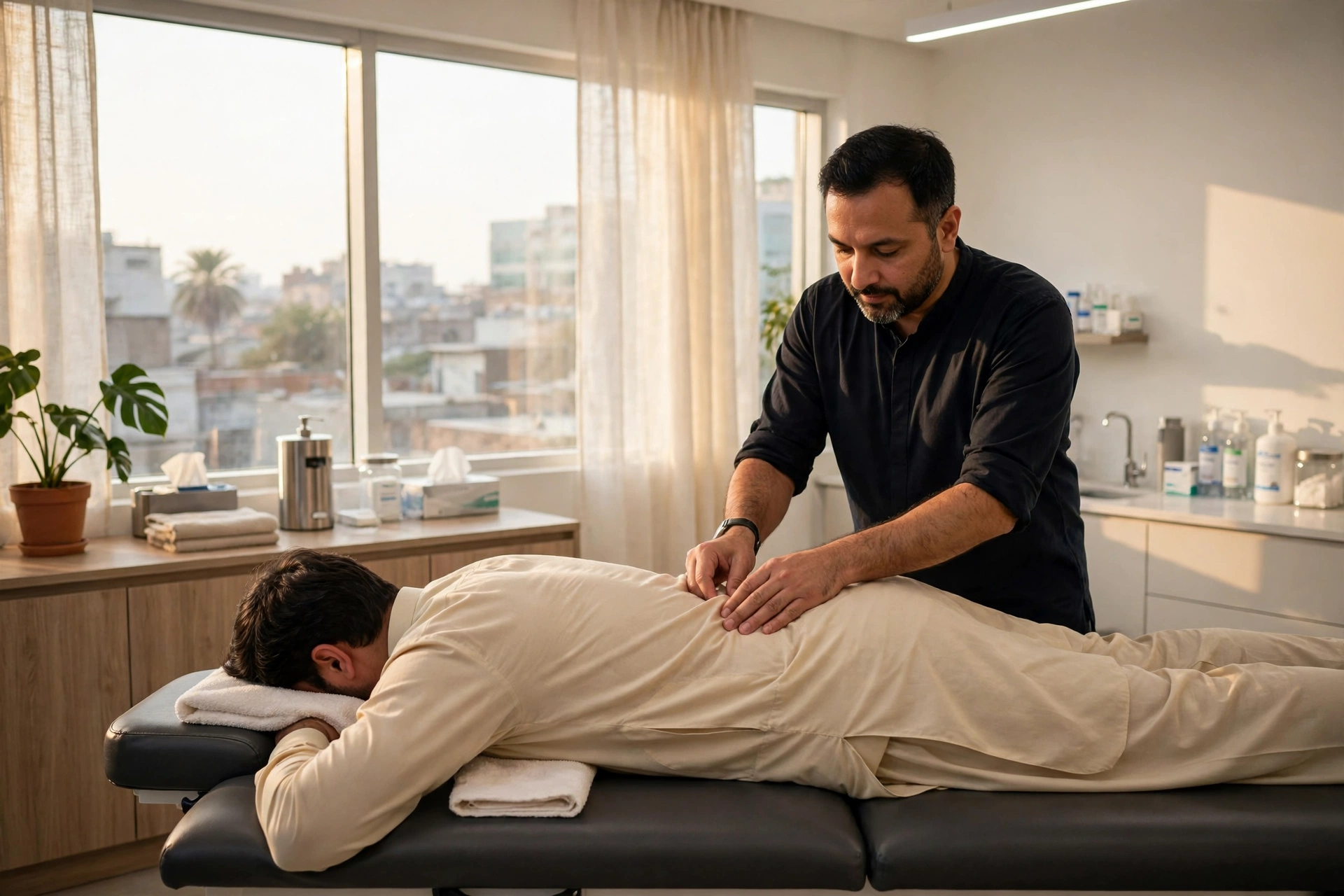
Bone setting and physiotherapy treat the same pain in different ways. Tit Tar bone setting works directly on joint alignment in a small number of hands on sessions, while physiotherapy rebuilds strength and movement through a structured exercise programme.
Neither one is right for every problem. The honest answer depends on what is causing your pain. This guide compares bone setting vs physiotherapy in Lahore fairly, looks at what research found, and explains when to see a doctor instead.
What Is Bone Setting (Tit Tar)?
Tit Tar is the traditional bone setting practice of Punjab, passed down through generations. The bone setter feels how a joint moves with hands alone, then applies controlled pressure and gentle movement to restore alignment. A session at Spartan Osteo Care in Allama Iqbal Town, Lahore, starts with an assessment of the painful area and nearby joints. There is no surgery and no medication. Read more in our guide to Tit Tar traditional bone setting.
Tit Tar is a traditional practice, not a hospital medical treatment. A responsible bone setter checks first whether your problem suits hands on care, and sends you to a doctor when it does not.
What Is Physiotherapy?
Physiotherapy is a licensed medical profession. A physiotherapist assesses your injury, makes a clinical diagnosis, and builds a plan around exercise, manual therapy and education. Most plans run over several weeks, with home exercises between visits. It works well after surgery, after a fracture has healed, and when weak muscles and stiff movement need retraining.
Bone setting and physiotherapy are not rivals. The question is which one fits your problem now.
Bone Setting vs Physiotherapy at a Glance
| Bone setting (Tit Tar) | Physiotherapy | |
|---|---|---|
| What it is | Traditional hands on joint care | Licensed medical rehabilitation |
| How it works | Controlled pressure and movement to restore joint alignment | Assessment, exercise, manual therapy and education |
| Typical course | Often a small number of sessions | A programme over several weeks |
| Best suited for | Joint stiffness and alignment related pain | Recovery after injury or surgery, weakness, rehabilitation |
| Main limit | Not a substitute for medical diagnosis | Needs time and regular attendance |
What the Research Actually Says
Two randomised trials from Finland compared traditional bone setting with physiotherapy.
The first, from 1997, followed 114 patients with back pain lasting more than seven weeks. Patients received bone setting, physiotherapy or guided exercise, up to ten one hour sessions over six weeks. Bone setting improved bending and pain scores more than exercise, but not more than physiotherapy. The authors concluded that neither bone setting nor exercise differed significantly from physiotherapy. Read the trial on PubMed.
The second, from 2007, followed 105 working adults with chronic neck pain for one year. All three groups felt better after one month. Disability scores and patient satisfaction were better after bone setting, and after one year 68.6 percent of the bone setting group reported significant improvement, against 40 to 45.5 percent in the other groups, with fewer sick days and less pain medicine. Read the trial on PubMed.
Read those results honestly. Two small, old trials from one country do not prove that bone setting beats physiotherapy, and they studied Finnish traditional bone setting, not Tit Tar in Lahore. What they show is that hands on bone setting can hold its own against physiotherapy.
Which One Fits Your Pain?
Use the problem itself to decide.
- Pain that keeps returning to the same joint, or stiffness that eases once you move: a bone setting assessment is a reasonable first step.
- Pain after surgery, a healed fracture, or visible weakness: physiotherapy is usually the right route.
- Desk related neck and shoulder pain: either can help. Bone setting frees the stiff joints, physiotherapy builds the exercise habit that keeps them moving. See our guide to postural realignment.
- Sciatica and leg pain that follows the back: the cause decides the care. Read how sciatica differs from ordinary back pain.
Some symptoms need a doctor before either option: numbness or weakness, pain after a fall or accident, a suspected fracture or dislocation, fever with back pain, unexplained weight loss, or pain that keeps getting worse.
Is Bone Setting Safe?
Safety depends on who does it and whether the problem was assessed first. Some physiotherapy clinics warn, fairly, that untrained bone setters can miss a fracture and delay proper care. That is why a proper Tit Tar assessment starts by ruling out the problems that hands on care cannot fix: suspected fractures, dislocations, nerve damage and red flag symptoms all go to a doctor first. Ask any practitioner what training they have. A clear, specific answer is a good sign.
Can You Use Both?
Yes. A common pattern is bone setting first to free a stiff joint, then guided exercise to keep it moving. Restore the movement first, then build the strength that holds it.
Frequently Asked Questions
Is Tit Tar the same as physiotherapy?
No. Tit Tar is traditional hands on bone setting, learned through apprenticeship and practice. Physiotherapy is a licensed medical profession built on university training, clinical diagnosis and exercise science. For back and neck pain, the trials above found broadly similar results.
How many sessions will I need?
That depends on the problem, and any honest clinic answers it after an assessment, not before. Bone setting often runs to a small number of sessions, physiotherapy to a programme over several weeks.
Should I see a bone setter or a physiotherapist for back pain?
For a recurring ache or stiffness with no warning signs, either is reasonable. After an accident, fracture or surgery, or with numbness or weakness, see a doctor first.
If you are in Lahore and unsure which route fits your pain, message Spartan Osteo Care on WhatsApp. We will say honestly whether a bone setting assessment is the right first step, or whether you should see a doctor first. The clinic is at 452 Gulshan Block, Allama Iqbal Town, Lahore.